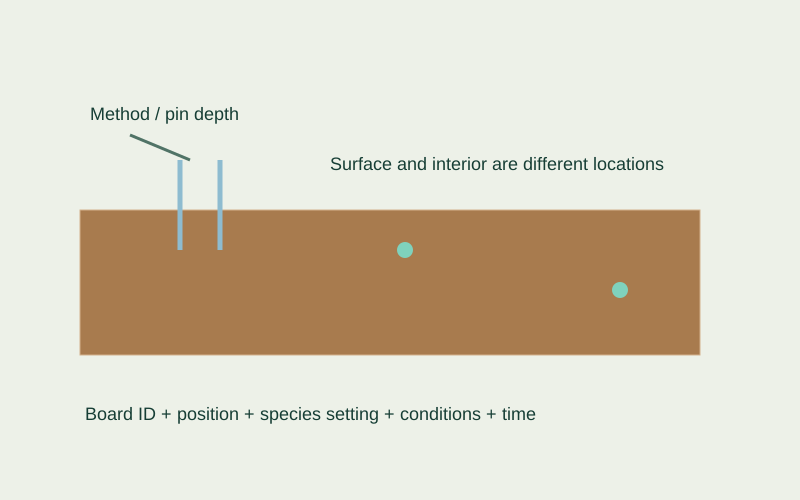
- Record the measurement method and the region it can assess.
- A surface observation does not establish the moisture condition throughout the section.
- Instrument correction and depth must follow the named meter and species documentation; dots are conceptual locations.
Ask what region the observation represents
A board can have different moisture conditions at different locations or depths. Electronic methods respond to their measurement region rather than directly weighing all the water in the board. USDA guidance discusses how gradients can complicate interpretation. Before calling a reading an average, establish whether the method supports that description for the material and conditions involved.
Understand why depth needs its own method
Pinless measurements can be influenced strongly by material nearer the surface when there is a large gradient. Resistance measurements depend in part on the electrode arrangement; insulated electrodes can support selected-depth investigation. These principles do not create a universal depth setting. Use the actual instrument and electrode instructions, including suitability for the board dimensions and condition.
Keep the investigation tied to a question
Visible wetting, a surprising observation, or disagreement between positions can justify a documented follow-up. First check the record for settings and technique. Then choose a method suited to the unresolved question, obtaining manufacturer or qualified project advice when necessary. Record what was checked and what remains unknown. More numbers are useful only if their locations and methods are clear.
- Label face and depth or mode separately.
- Do not mix different positions into a trend without explanation.
- Preserve original observations when follow-up values are added.
- Avoid inventing a core value from a surface reading.
Describe the limitation in plain language
Use statements such as 'observed at the recorded face with the listed mode' or 'interior condition not established by this observation.' Such wording helps a reviewer understand the evidence without making a diagnosis. A series of similar surface readings does not itself eliminate every possible depth difference, and an unusual reading does not by itself identify the cause.
Hypothetical recently wetted face
One exposed face receives rain before the bundle is moved under cover. The operator records the wetting location and the meter observation there. A later assessment asks whether the recorded face represents the board more broadly. The follow-up documents suitable equipment and positions; it does not estimate the interior by subtracting an arbitrary amount from the original value.
Common questions
Can I calculate core moisture from a surface reading?
This guide provides no such conversion. The relationship depends on conditions and measurement method; use a suitable investigation procedure.
Does a different reading at depth prove why the difference occurred?
No. It adds an observation. Storage history, method, settings, and other evidence are needed before assigning a cause.
Evidence & limits
Reviewed September 13, 2026. Sources support their stated technical principles; this site's workflows and hypothetical examples are not product tests, supplier approvals or independently reviewed project records.