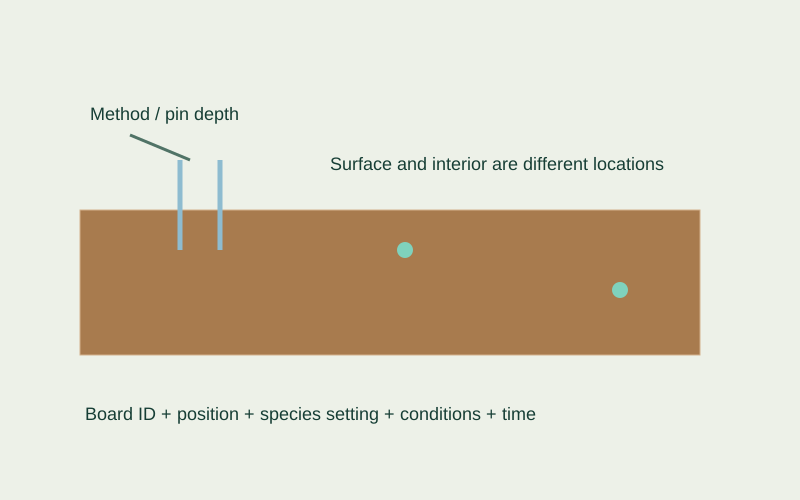
- Record the measurement method and the region it can assess.
- A surface observation does not establish the moisture condition throughout the section.
- Instrument correction and depth must follow the named meter and species documentation; dots are conceptual locations.
Start with the measurement task
Choose equipment around the material and the question, not simply whether it leaves a mark. You might be documenting accessible faces, investigating a particular board, or repeating an established procedure. Note the board thickness, surface access, product condition, and any restrictions on marking it. Then consult the actual instrument manual. A generic description of a meter family is not a specification for every model in that family.
Understand the two measurement families
Resistance meters use penetrating electrodes to infer moisture from an electrical property. Dielectric meters use surface electrodes. USDA research explains that moisture distribution can affect the result, so neither family should be treated as a device that automatically reports a whole board's average under every condition. Suitable insulated electrodes can help investigate selected depths; their use still depends on the electrode and instrument instructions.
Read the model limits before making comparisons
Check the manual for the supported material, thickness, measuring range, species adjustment, orientation, and contact requirements. Save the relevant manual reference in your record. Two different meters can differ in method and sampling region. If their results disagree, first document those differences. Do not average the readings together merely because both screens display a percent sign.
- Identify the exact model and electrode or sensor mode.
- Record settings and applied corrections.
- Keep observations from different methods distinguishable.
- Ask the manufacturer about conditions the manual does not cover.
Use screening and follow-up deliberately
A consistent series of observations can identify a location that merits another look. The follow-up should answer a defined question, such as whether a setting was wrong or whether another depth needs investigation. Preserve both the original observation and the follow-up. Changing equipment without recording why can create apparent trends that reflect the method rather than the material.
Hypothetical disagreement between methods
An owner has a pinless observation from a board face and a pin observation from another position. The numbers differ. Instead of choosing the preferred number, the record lists the two models, settings, positions, and modes. The owner consults their manuals and arranges a comparable follow-up. Neither initial result is labeled a whole-board average.
Common questions
Is pinless always better because it avoids holes?
Avoiding punctures may matter to the task, but it does not resolve thickness, contact, material, or moisture-distribution limitations. Use the model instructions.
Can I substitute a new meter into an existing log?
Yes, but mark the equipment change. A comparison session using documented methods may be more informative than assuming the old and new observations are interchangeable.
Evidence & limits
Reviewed September 13, 2026. Sources support their stated technical principles; this site's workflows and hypothetical examples are not product tests, supplier approvals or independently reviewed project records.