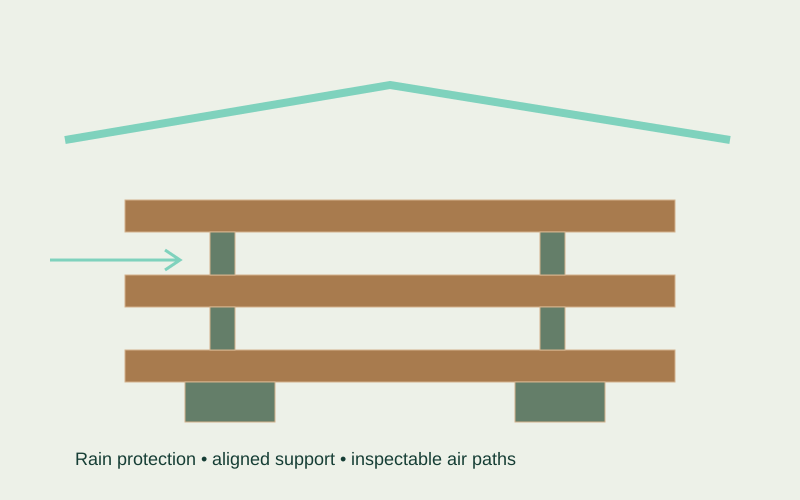
- Protect from direct wetting while preserving appropriate ventilation.
- Keep supports aligned and the stack above the ground on a stable base.
- This is a storage concept, not a universal sticker spacing or acclimation time recommendation.
Keep the transit history distinct from the destination
Wood arriving in a dry area may have spent time in a different storage environment. Ask for available product and shipment documentation, and preserve what is known without inventing the missing history. Record the arrival condition before moving or unpacking the material. A destination's reputation for dry weather does not tell you the moisture condition of stock inside the arriving bundle.
Describe the proposed storage conditions
Identify direct exposure, cover, support, and the supplied handling instructions. Do not place material in stronger sun or add heat simply to accelerate a presumed acclimation schedule. USDA discusses moisture changes during storage and drying; this does not supply a universal jobsite drying recipe. Select the arrangement required for the product and record any uncertainty that needs clarification before changing that arrangement.
Measure the material instead of extrapolating from the air
If ambient conditions are recorded, keep them in separate fields with their time and location. Use the meter's documented settings and measurement procedure for the stock. A surface observation may not describe deeper material when a gradient exists. Therefore, neither a low ambient humidity reading nor a dry-looking face proves that every portion of a thick or previously wetted board has the same condition.
Make transitions visible in the follow-up
Record when the bundle leaves transport, enters storage, or moves again. Revisit identified positions with a comparable method and flag any settings or equipment changes. Do not interpret adjustment as always meaning additional drying: wood exchanges moisture according to its actual condition and surroundings. Compare the observations with the relevant product requirements, not with a target assigned to a ZIP code.
- Keep arrival observations before later follow-up entries.
- Document storage changes rather than restarting the log.
- Preserve individual board values alongside any summary.
Hypothetical shipment to a dry inland site
A bundle arrives from an unknown transit environment and is assigned shaded storage under its handling instructions. The owner records the arrival observations and separately measures the storage-area air. When the stack is later moved to another bay, that transition is dated. The worksheet does not fill missing board readings from the ambient conditions or promise a shorter wait because the site is inland.
Common questions
Does low relative humidity guarantee fast acclimation?
It does not establish a universal time for the delivered product. Material condition, dimensions, handling, and the actual environment need consideration.
Can I heat the stock to finish sooner?
Do not improvise a drying treatment from this guide. Follow the product's instructions and obtain applicable guidance before changing its storage environment.
Evidence & limits
Reviewed September 13, 2026. Sources support their stated technical principles; this site's workflows and hypothetical examples are not product tests, supplier approvals or independently reviewed project records.